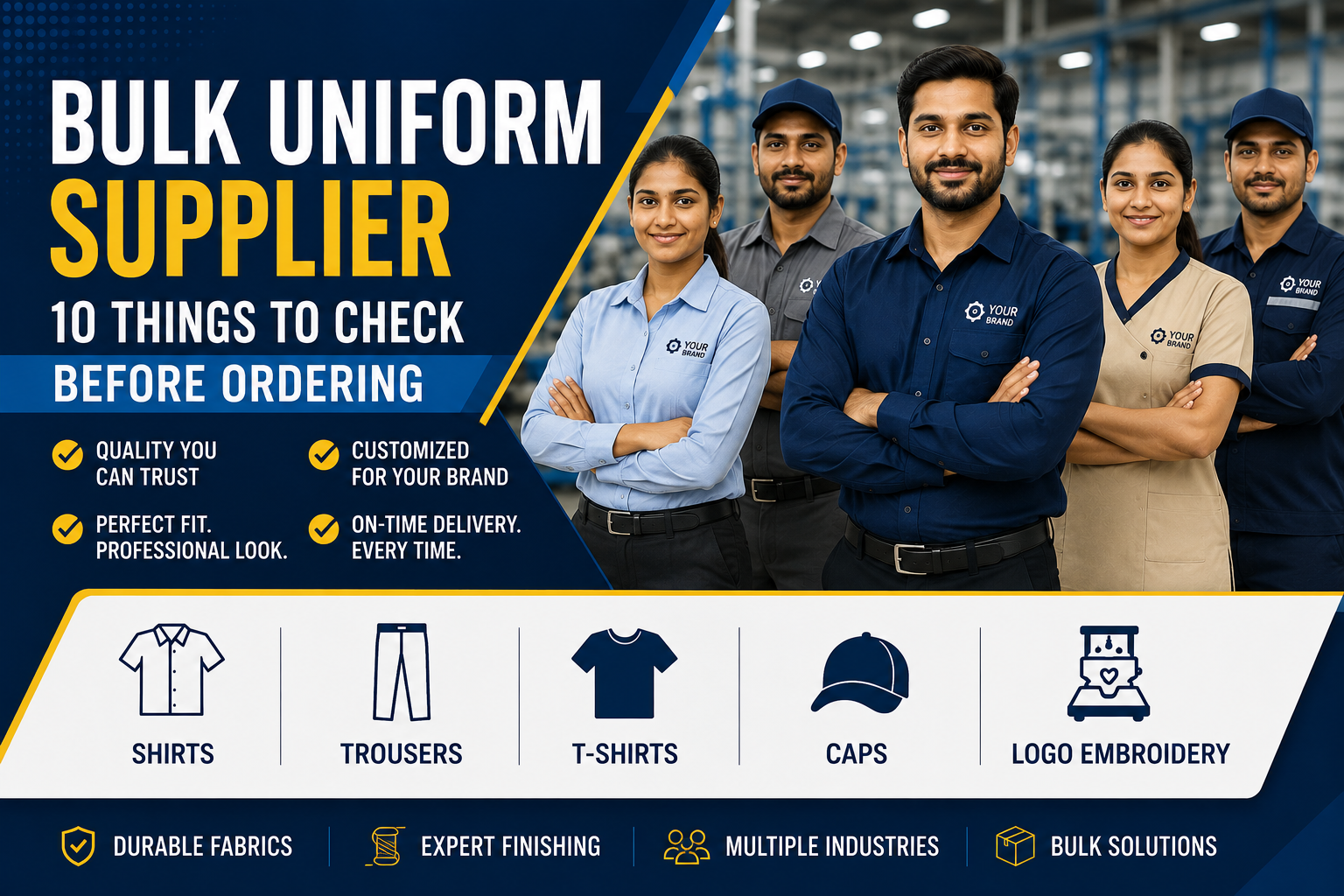
Choosing the right bulk uniform supplier is an important decision for businesses, institutions and organizations that need uniforms in large quantities.
Whether you are ordering corporate uniforms, industrial uniforms, hotel uniforms, hospital uniforms, school uniforms, employee T-shirts, caps or other customized garments, the supplier you select can directly influence fabric quality, comfort, sizing, branding consistency, durability, pricing and delivery.
The lowest quotation is not always the best option.
Before placing bulk uniform orders, businesses should evaluate the supplier’s manufacturing capability, fabric options, customization services, quality-control process, production capacity, sizing support and ability to manage future repeat orders.
What should you look for in a bulk uniform supplier?
A reliable bulk uniform supplier should be able to provide the right combination of:
- Suitable fabric
- Comfortable fit
- Consistent sizing
- Customization
- Branding
- Production capacity
- Quality control
- Transparent pricing
- Reliable delivery
- Repeat-order support
Here are the 10 most important factors to check before choosing a uniform supplier for bulk orders.
1. Check the Bulk Uniform Supplier’s Manufacturing Capabilities
Before placing a large order, understand whether the company is a manufacturer, supplier, reseller or a combination of these.
For customized and large-volume requirements, working with a supplier that has suitable manufacturing capabilities can simplify coordination.
This becomes particularly important when your requirement includes:
- Multiple garment styles
- Multiple employee sizes
- Custom colours
- Logo embroidery
- Department-specific uniforms
- Large quantities
- Repeat orders
Questions to Ask a Bulk Uniform Manufacturer
Before finalizing the supplier, ask:
- What types of uniforms do you manufacture or supply?
- What order quantities can you handle?
- Can you manage customized requirements?
- What is your normal production lead time?
- Can you reproduce the same specifications for repeat orders?
- Which production stages are handled in-house?
Clear answers will help you determine whether the bulk uniform manufacturer has the capacity and process required for your order.
2. Evaluate Fabric Quality Before Ordering Uniforms in Bulk
Fabric is one of the most important factors in any uniform.
The right fabric depends on who will wear the uniform, where it will be used, how often it will be worn and the working environment.
For example, the fabric suitable for office employees may be different from the fabric required for factory workers, hospitality staff, healthcare professionals or school students.
A professional uniform supplier should recommend fabrics according to the intended application rather than suggesting the same option for every business.
What Should You Check in Uniform Fabric?
Consider factors such as:
- Comfort
- Breathability
- Fabric weight
- Durability
- Ease of washing
- Colour retention
- Wrinkle resistance
- Frequency of use
- Working environment
- Seasonal requirements
Whenever possible, ask your supplier for fabric samples before approving a large order.
This helps you compare the material physically before moving into bulk production.
3. Check Customization and Branding Options
Uniforms do more than identify employees. They also contribute to your organization’s professional appearance and brand identity.
Your custom uniform manufacturer should therefore be able to translate your branding requirements into garments that are practical, comfortable and visually consistent.
Common Custom Uniform Options
Depending on your requirements, customization may include:
- Logo embroidery
- Computerized embroidery
- Custom colours
- Fabric selection
- Custom sizing
- Department-specific uniforms
- Corporate T-shirts
- Caps
- Bags
- Jackets
- Other branded apparel
Before manufacturing begins, confirm:
- Logo size
- Logo position
- Brand colours
- Garment colour
- Embroidery specifications
- Final garment design
Approving these details before production can help prevent inconsistencies across your bulk order.
4. Review the Supplier’s Experience Across Different Industries
Uniform requirements can vary significantly from one industry to another.
A bulk uniform supplier with experience across multiple sectors is more likely to understand how garment requirements change depending on the workplace and employee role.
Common Types of Bulk Uniforms
Corporate Uniforms
Corporate uniforms help create a consistent and professional appearance for employees and customer-facing teams.
Industrial Uniforms
Industrial uniforms should be selected according to workplace conditions, movement, durability requirements and practical daily usage.
Hotel Uniforms
Hospitality businesses may require different garments for:
- Reception
- Housekeeping
- Kitchen
- Food service
- Management
- Other operational teams
Hospital Uniforms
Healthcare uniforms are generally selected according to employee roles, working conditions, comfort and practical requirements.
School Uniforms
School uniforms should provide consistency, appropriate fit, comfort and durability for regular use.
Choose a uniform manufacturer for bulk orders that understands the specific requirements of your industry rather than offering a one-size-fits-all solution.
5. Confirm Sizing and Fit Before Bulk Production
High-quality fabric cannot compensate for an uncomfortable or poorly fitting uniform.
Sizing becomes especially important when ordering uniforms for a large team because employees may have different body types and size requirements.
Before approving bulk uniform orders, understand how your supplier handles measurements and size distribution.
Ask Your Uniform Supplier About
- Available size ranges
- Size charts
- Measurement process
- Sample sizes
- Size-set approval
- Alteration options
- Special-size requirements
For larger orders, consider approving a size set before bulk manufacturing begins.
This simple step can help reduce sizing problems, alterations and replacements later.
6. Ask for Samples Before Final Production
A sample is one of the most useful tools when ordering custom uniforms in bulk.
A pre-production sample allows you to physically evaluate the proposed garment before hundreds of units are manufactured.
What Should You Check in a Uniform Sample?
Review:
- Fabric quality
- Fabric weight
- Fit
- Stitching
- Colour
- Logo placement
- Embroidery quality
- Buttons
- Zippers
- Accessories
- Garment finishing
- Comfort
- Ease of movement
If any modification is required, communicate it before approving the final production.
Correcting a sample is far easier than identifying the same problem after the complete order has been manufactured.
7. Compare Uniform Pricing Based on Overall Value
Price is naturally an important consideration when choosing a bulk uniform supplier, but businesses should avoid selecting a supplier based only on the lowest per-piece quotation.
Two suppliers may quote very different prices because their fabric, stitching, customization, packaging or other specifications are different.
What Affects Bulk Uniform Pricing?
Uniform prices may vary according to:
- Fabric type
- Fabric quality
- Garment design
- Order quantity
- Size distribution
- Embroidery
- Printing
- Number of branding positions
- Custom accessories
- Packaging
- Delivery requirements
Ask for a clear quotation that explains what is included.
A uniform that costs slightly more but offers better quality, durability and consistency may deliver better long-term value than a cheaper garment that requires frequent replacement.
8. Verify Production Capacity and Delivery Timelines
Delayed uniforms can create operational challenges when garments are needed for:
- Employee onboarding
- New branch openings
- Hotel launches
- Factory requirements
- School terms
- Events
- Promotional campaigns
Before confirming an order, ask your bulk uniform manufacturer for a realistic production and delivery schedule.
Confirm These Details Before Ordering
- Total order quantity
- Sample approval date
- Production lead time
- Branding lead time
- Dispatch schedule
- Delivery location
- Urgent-order feasibility
- Repeat-order lead time
Avoid depending only on verbal commitments.
Document the agreed specifications, quantities and timelines before production begins.
For very large uniform requirements, you can also ask whether phased delivery is available.
9. Understand the Supplier’s Quality-Control Process
Quality consistency becomes more important as order quantities increase.
An excellent sample does not automatically guarantee that every garment in a large order will have the same finish.
This is why understanding the supplier’s quality-control process is important before selecting a bulk uniform supplier.
Important Uniform Quality Checks
The supplier may need to inspect:
- Stitching consistency
- Fabric consistency
- Correct sizing
- Logo placement
- Embroidery finish
- Colour consistency
- Garment finishing
- Quantity
- Packaging
Ask how finished garments are inspected before dispatch.
A systematic quality-control process can help reduce avoidable errors and improve consistency across large uniform orders.
10. Check Repeat-Order and After-Sales Support
Uniform procurement rarely ends after the first order.
Over time:
- New employees join
- Existing employees require replacement uniforms
- Sizes change
- New departments open
- Companies expand
- Additional uniforms may be required
That makes repeat-order support important when choosing a corporate uniform supplier or industrial uniform manufacturer.
Ask About Future Uniform Requirements
Before finalizing the supplier, ask:
- Can the same uniform design be reordered?
- Can replacement quantities be supplied?
- Are previous specifications maintained?
- How are additional sizes managed?
- Can uniforms for new employees match the original order?
- Who will manage future requirements?
Working with a dependable supplier can make future uniform procurement much easier.
Quick Checklist for Choosing a Bulk Uniform Supplier
Before placing your order, make sure you have checked:
- Manufacturing and supply capability
- Fabric quality and suitability
- Customization and branding options
- Relevant industry experience
- Sizing and fit process
- Sample and pre-production approval
- Transparent pricing
- Production capacity and delivery timeline
- Quality-control process
- Repeat-order and after-sales support
If a supplier can clearly address these areas, you will be in a stronger position to make an informed decision.
How to Choose the Best Bulk Uniform Supplier for Your Business
The best bulk uniform supplier is not necessarily the company offering the lowest price.
A dependable supplier should understand your requirements and provide the right balance of:
- Fabric quality
- Comfort
- Fit
- Customization
- Branding
- Quantity
- Pricing
- Manufacturing capacity
- Delivery
Before requesting a quotation, define your requirements clearly.
Who Will Wear the Uniform?
Identify whether the garments are intended for office employees, factory workers, hospitality teams, healthcare professionals, students or other users.
Where Will the Uniform Be Used?
Consider whether employees will wear it in an office, factory, hotel, hospital, school, outdoor workplace or another environment.
How Frequently Will It Be Worn?
Uniforms used every day may require different fabric and durability considerations from garments used occasionally.
What Branding Do You Need?
Define:
- Brand colours
- Logo
- Embroidery
- Printing
- Garment design
- Logo placement
How Many Uniforms Do You Need?
Your total quantity and size distribution can influence production planning, pricing and delivery timelines.
Once these requirements are clear, comparing different uniform suppliers becomes easier and more meaningful.
Bulk Uniform Solutions from Elegance Garments
Elegance Garments provides garment and uniform solutions for various business and institutional requirements, including:
- Corporate uniforms
- Industrial uniforms
- Hotel uniforms
- Hospital uniforms
- School uniforms
- T-shirts
- Caps
- Bags
- Computerized embroidery
Organizations planning a customized or bulk uniform requirement should first define their preferred garment type, fabric, branding, sizing, quantity and expected delivery schedule.
Discussing these requirements before production helps create a uniform solution that is better aligned with your organization and the people who will wear it.
Planning a Bulk Uniform Order?
Contact Elegance Garments to discuss your uniform requirements, quantity, fabric options, sizing, customization and branding needs.
CTA: Request a Bulk Uniform Quote
Frequently Asked Questions About Bulk Uniform Orders
1. What should I check before choosing a bulk uniform supplier?
Before selecting a bulk uniform supplier, evaluate manufacturing capability, fabric quality, customization, industry experience, sizing, samples, pricing, production capacity, quality control, delivery timelines and repeat-order support.
2. How do I choose the right fabric for employee uniforms?
Choose uniform fabric according to the working environment, climate, employee role, frequency of use, comfort, durability and washing requirements. Ask your supplier for appropriate fabric options and samples before approving a large order.
3. Can company logos be embroidered on custom uniforms?
Yes. Company logos can commonly be added through embroidery or other suitable branding methods. Approve the logo size, colour, placement and sample finish before bulk manufacturing.
4. Should I ask for a sample before placing a bulk uniform order?
Yes. A sample can help you check the fabric, stitching, fit, colour, logo placement, embroidery and overall garment quality before approving bulk production.
5. How long does a bulk uniform order take?
Production time depends on the quantity, garment design, fabric availability, customization, branding requirements, sample approval and delivery location. Ask the supplier for a timeline based on your actual order requirements.
6. What information should I provide when requesting a bulk uniform quotation?
Provide:
- Uniform type
- Estimated quantity
- Size distribution
- Fabric preference
- Garment colours
- Logo and branding requirements
- Customization details
- Delivery location
- Required delivery date
Providing complete information helps the supplier prepare a more accurate quotation.
7. Is a uniform manufacturer better than a reseller for bulk orders?
Not necessarily. The right supplier depends on manufacturing capability, quality, customization, production capacity, pricing, service and delivery reliability. Direct manufacturing capabilities may provide greater control for certain customized or large-volume requirements.
8. Can different departments have different uniform designs?
Yes. Businesses can use different styles, colours, embroidery or design elements for individual departments while maintaining consistent overall brand identity.
9. How can businesses maintain consistency in repeat uniform orders?
Maintain approved specifications for fabric, garment colour, sizing, construction, embroidery, logo placement and other branding elements. Working with a supplier that keeps previous specifications can also make repeat orders easier.
10. Where can businesses order customized uniforms in bulk?
Businesses can order custom uniforms in bulk from a manufacturer or supplier capable of meeting their requirements for garment type, fabric, sizing, branding, quantity, quality and delivery.
Elegance Garments provides uniform and garment solutions for corporate, industrial, hospitality, healthcare, school and other institutional requirements.